EARTH [PAR:1]T
Earth
Earth 
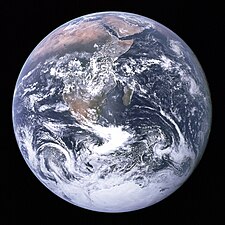
The Blue Marble photograph of Earth, taken during the Apollo 17lunar mission in 1972
Orbital characteristics Epoch J2000[n 1] Aphelion 152100000 km[n 2]
(94500000 mi; 1.017 AU) Perihelion 147095000 km[n 2]
(91401000 mi; 0.98327 AU)
149598023 km[1]
(92955902 mi; 1.00000102 AU) Eccentricity 0.0167086[1]
365.256363004 d[2]
(1.00001742096 yr)
Average orbital speed
29.78 km/s[3]
(107200 km/h; 66600 mph)
358.617° Inclination
- 7.155° to the Sun's equator;
- 1.57869°[4] to invariable plane;
- 0.00005° to J2000 ecliptic
−11.26064°[3] to J2000 ecliptic
114.20783°[3] Satellites
- 1 natural satellite: the Moon
- 5 quasi-satellites
- >1 400 operational artificial satellites[5]
- >16 000 space debris[n 3]
Physical characteristics
Mean radius
6371.0 km (3958.8 mi)[6]
Equatorialradius
6378.1 km (3963.2 mi)[7][8]
Polar radius
6356.8 km (3949.9 mi)[9] Flattening 0.0033528[10]
1/298.257222101 (ETRS89) Circumference
- 40075.017 km equatorial (24901.461 mi)[8]
- 40007.86 km meridional (24859.73 mi)[11][12]
Volume 1.08321×10¹² km3 (2.59876×10¹¹ cu mi)[3] Mass 5.97237×1024 kg (1.31668×1025 lb)[15]
(3.0×10⁻⁶ M☉)
Mean density
5.514 g/cm3 (0.1992 lb/cu in)[3]
9.807 m/s2 (1 g; 32.18 ft/s2)[16]
0.3307[17]
11.186 km/s[3]
(40270 km/h; 25020 mph)
Sidereal rotation period
Equatorial rotation velocity
0.4651 km/s[19]
(1674.4 km/h; 1040.4 mph)
23.4392811°[2] Albedo
Surface temp. min mean max Kelvin 184 K[20] 288 K[21] 330 K[22] Celsius −89.2 °C 15 °C 56.7 °C Fahrenheit −128.5 °F 59 °F 134 °F
Atmosphere
Surface pressure
101.325 kPa (at MSL) Composition by volume
- 78.08% nitrogen (N2; dry air)[3]
- 20.95% oxygen (O2)
- 0.930% argon
- 0.0402% carbon dioxide[23]
- ~ 1% water vapor (climate-variable)
Earth is the third planet from the Sun and the only object in the Universe known to harbor life. According to radiometric dating and other sources of evidence, Earth formed over 4 billion years ago.[24][25][26] Earth's gravity interacts with other objects in space, especially the Sun and the Moon, Earth's only natural satellite. During one orbit around the Sun, Earth rotates about its axis about 365.26 times; thus, an Earth year is about 365.26 days long.[n 5]
Earth's axis of rotation is tilted, producing seasonal variations on the planet's surface.[27] The gravitational interactionbetween the Earth and Moon causes ocean tides, stabilizes the Earth's orientation on its axis, and gradually slows its rotation.[28] Earth is the densest planet in the Solar System and the largest of the four terrestrial planets.
Earth's lithosphere is divided into several rigid tectonic plates that migrate across the surface over periods of many millions of years. About 71% of Earth's surface is covered with water, mostly by its oceans.[29] The remaining 29% is land consisting of continents and islands that together have many lakes, rivers and other sources of water that contribute to the hydrosphere. The majority of Earth's polar regions are covered in ice, including the Antarctic ice sheetand the sea ice of the Arctic ice pack. Earth's interior remains active with a solid iron inner core, a liquid outer core that generates the Earth's magnetic field, and a convecting mantle that drives plate tectonics.
Within the first billion years of Earth's history, life appeared in the oceans and began to affect the Earth's atmosphereand surface, leading to the proliferation of aerobic and anaerobic organisms. Some geological evidence indicates that life may have arisen as much as 4.1 billion years ago. Since then, the combination of Earth's distance from the Sun, physical properties, and geological history have allowed life to evolve and thrive.[30][31] In the history of the Earth, biodiversity has gone through long periods of expansion, occasionally punctuated by mass extinction events. Over 99% of all species[32] that ever lived on Earth are extinct.[33][34] Estimates of the number of species on Earth today vary widely;[35][36][37] most species have not been described.[38] Over 7.4 billion humans live on Earth and depend on its biosphere and minerals for their survival. Humans have developed diverse societies and cultures; politically, the world has about 200 sovereign states.

The Blue Marble photograph of Earth, taken during the Apollo 17lunar mission in 1972
| |||||||||||||||||
| Orbital characteristics | |||||||||||||||||
|---|---|---|---|---|---|---|---|---|---|---|---|---|---|---|---|---|---|
| Epoch J2000[n 1] | |||||||||||||||||
| Aphelion | 152100000 km[n 2] (94500000 mi; 1.017 AU) | ||||||||||||||||
| Perihelion | 147095000 km[n 2] (91401000 mi; 0.98327 AU) | ||||||||||||||||
| 149598023 km[1] (92955902 mi; 1.00000102 AU) | |||||||||||||||||
| Eccentricity | 0.0167086[1] | ||||||||||||||||
| 365.256363004 d[2] (1.00001742096 yr) | |||||||||||||||||
Average orbital speed
| 29.78 km/s[3] (107200 km/h; 66600 mph) | ||||||||||||||||
| 358.617° | |||||||||||||||||
| Inclination |
| ||||||||||||||||
| −11.26064°[3] to J2000 ecliptic | |||||||||||||||||
| 114.20783°[3] | |||||||||||||||||
| Satellites |
| ||||||||||||||||
| Physical characteristics | |||||||||||||||||
Mean radius
| 6371.0 km (3958.8 mi)[6] | ||||||||||||||||
Equatorialradius
| 6378.1 km (3963.2 mi)[7][8] | ||||||||||||||||
Polar radius
| 6356.8 km (3949.9 mi)[9] | ||||||||||||||||
| Flattening | 0.0033528[10] 1/298.257222101 (ETRS89) | ||||||||||||||||
| Circumference |
| ||||||||||||||||
| Volume | 1.08321×10¹² km3 (2.59876×10¹¹ cu mi)[3] | ||||||||||||||||
| Mass | 5.97237×1024 kg (1.31668×1025 lb)[15] (3.0×10⁻⁶ M☉) | ||||||||||||||||
Mean density
| 5.514 g/cm3 (0.1992 lb/cu in)[3] | ||||||||||||||||
| 9.807 m/s2 (1 g; 32.18 ft/s2)[16] | |||||||||||||||||
| 0.3307[17] | |||||||||||||||||
| 11.186 km/s[3] (40270 km/h; 25020 mph) | |||||||||||||||||
Sidereal rotation period
| |||||||||||||||||
Equatorial rotation velocity
| 0.4651 km/s[19] (1674.4 km/h; 1040.4 mph) | ||||||||||||||||
| 23.4392811°[2] | |||||||||||||||||
| Albedo | |||||||||||||||||
| |||||||||||||||||
| Atmosphere | |||||||||||||||||
Surface pressure
| 101.325 kPa (at MSL) | ||||||||||||||||
| Composition by volume |
| ||||||||||||||||

Earth is the third planet from the Sun and the only object in the Universe known to harbor life. According to radiometric dating and other sources of evidence, Earth formed over 4 billion years ago.[24][25][26] Earth's gravity interacts with other objects in space, especially the Sun and the Moon, Earth's only natural satellite. During one orbit around the Sun, Earth rotates about its axis about 365.26 times; thus, an Earth year is about 365.26 days long.[n 5]
Earth's axis of rotation is tilted, producing seasonal variations on the planet's surface.[27] The gravitational interactionbetween the Earth and Moon causes ocean tides, stabilizes the Earth's orientation on its axis, and gradually slows its rotation.[28] Earth is the densest planet in the Solar System and the largest of the four terrestrial planets.
Earth's lithosphere is divided into several rigid tectonic plates that migrate across the surface over periods of many millions of years. About 71% of Earth's surface is covered with water, mostly by its oceans.[29] The remaining 29% is land consisting of continents and islands that together have many lakes, rivers and other sources of water that contribute to the hydrosphere. The majority of Earth's polar regions are covered in ice, including the Antarctic ice sheetand the sea ice of the Arctic ice pack. Earth's interior remains active with a solid iron inner core, a liquid outer core that generates the Earth's magnetic field, and a convecting mantle that drives plate tectonics.
Within the first billion years of Earth's history, life appeared in the oceans and began to affect the Earth's atmosphereand surface, leading to the proliferation of aerobic and anaerobic organisms. Some geological evidence indicates that life may have arisen as much as 4.1 billion years ago. Since then, the combination of Earth's distance from the Sun, physical properties, and geological history have allowed life to evolve and thrive.[30][31] In the history of the Earth, biodiversity has gone through long periods of expansion, occasionally punctuated by mass extinction events. Over 99% of all species[32] that ever lived on Earth are extinct.[33][34] Estimates of the number of species on Earth today vary widely;[35][36][37] most species have not been described.[38] Over 7.4 billion humans live on Earth and depend on its biosphere and minerals for their survival. Humans have developed diverse societies and cultures; politically, the world has about 200 sovereign states.
Contents
Name and etymology
The modern English word Earth developed from a wide variety of Middle English forms,[n 6] which derived from an Old English noun most often spelled eorðe.[39] It has cognates in every Germanic language, and their proto-Germanic root has been reconstructed as *erþō. In its earliest appearances, eorðe was already being used to translate the many senses of Latin terra and Greek γῆ (gē): the ground,[n 7] its soil,[n 8] dry land,[n 9] the human world,[n 10] the surface of the world (including the sea),[n 11] and the globe itself.[n 12] As with Terra and Gaia, Earth was a personified goddess in Germanic paganism: the Angles were listed by Tacitus as among the devotees of Nerthus,[48] and later Norse mythology included Jörð, a giantess often given as the mother of Thor.[49]
Originally, earth was written in lowercase, and from early Middle English, its definite sense as "the globe" was expressed as the earth. By early Modern English, many nouns were capitalized, and the earth became (and often remained) the Earth, particularly when referenced along with other heavenly bodies. More recently, the name is sometimes simply given as Earth, by analogy with the names of the other planets.[39] House styles now vary: Oxford spelling recognizes the lowercase form as the most common, with the capitalized form an acceptable variant. Another convention capitalizes "Earth" when appearing as a name (e.g. "Earth's atmosphere") but writes it in lowercase when preceded by the (e.g. "the atmosphere of the earth"). It almost always appears in lowercase in colloquial expressions such as "what on earth are you doing?"[50]
The modern English word Earth developed from a wide variety of Middle English forms,[n 6] which derived from an Old English noun most often spelled eorðe.[39] It has cognates in every Germanic language, and their proto-Germanic root has been reconstructed as *erþō. In its earliest appearances, eorðe was already being used to translate the many senses of Latin terra and Greek γῆ (gē): the ground,[n 7] its soil,[n 8] dry land,[n 9] the human world,[n 10] the surface of the world (including the sea),[n 11] and the globe itself.[n 12] As with Terra and Gaia, Earth was a personified goddess in Germanic paganism: the Angles were listed by Tacitus as among the devotees of Nerthus,[48] and later Norse mythology included Jörð, a giantess often given as the mother of Thor.[49]
Originally, earth was written in lowercase, and from early Middle English, its definite sense as "the globe" was expressed as the earth. By early Modern English, many nouns were capitalized, and the earth became (and often remained) the Earth, particularly when referenced along with other heavenly bodies. More recently, the name is sometimes simply given as Earth, by analogy with the names of the other planets.[39] House styles now vary: Oxford spelling recognizes the lowercase form as the most common, with the capitalized form an acceptable variant. Another convention capitalizes "Earth" when appearing as a name (e.g. "Earth's atmosphere") but writes it in lowercase when preceded by the (e.g. "the atmosphere of the earth"). It almost always appears in lowercase in colloquial expressions such as "what on earth are you doing?"[50]
Chronology
Formation
The oldest material found in the Solar System is dated to 4.5672±0.0006 billion years ago (Gya).[51] By 4.54±0.04 Gya[52] the primordial Earth had formed. The formation and evolution of Solar System bodies occurred along with the Sun. In theory, a solar nebula partitions a volume out of a molecular cloud by gravitational collapse, which begins to spin and flatten into a circumstellar disk, and then the planets grow out of that disk along with the Sun. A nebula contains gas, ice grains, and dust (including primordial nuclides). According to nebular theory, planetesimals formed by accretion, with the primordial Earth taking 10–20 million years (Ma) to form.[53]
A subject of on-going research is the formation of the Moon, some 4.53 billion years ago.[54] A working hypothesis is that it was formed by accretion from material loosed from Earth after a Mars-sized object, named Theia, impacted Earth.[55] In this scenario, the mass of Theia was approximately 10% of that of Earth,[56] it impacted Earth with a glancing blow,[57] and some of its mass merged with Earth. Between approximately 4.1 and 3.8 Gya, numerous asteroid impacts during the Late Heavy Bombardment caused significant changes to the greater surface environment of the Moon, and by inference, to that of Earth.

The oldest material found in the Solar System is dated to 4.5672±0.0006 billion years ago (Gya).[51] By 4.54±0.04 Gya[52] the primordial Earth had formed. The formation and evolution of Solar System bodies occurred along with the Sun. In theory, a solar nebula partitions a volume out of a molecular cloud by gravitational collapse, which begins to spin and flatten into a circumstellar disk, and then the planets grow out of that disk along with the Sun. A nebula contains gas, ice grains, and dust (including primordial nuclides). According to nebular theory, planetesimals formed by accretion, with the primordial Earth taking 10–20 million years (Ma) to form.[53]
A subject of on-going research is the formation of the Moon, some 4.53 billion years ago.[54] A working hypothesis is that it was formed by accretion from material loosed from Earth after a Mars-sized object, named Theia, impacted Earth.[55] In this scenario, the mass of Theia was approximately 10% of that of Earth,[56] it impacted Earth with a glancing blow,[57] and some of its mass merged with Earth. Between approximately 4.1 and 3.8 Gya, numerous asteroid impacts during the Late Heavy Bombardment caused significant changes to the greater surface environment of the Moon, and by inference, to that of Earth.
Geological history
Earth's atmosphere and oceans were formed by volcanic activity and outgassing that included water vapor. The origin of the world's oceanswas condensation augmented by water and ice delivered by asteroids, protoplanets, and comets.[58] In this model, atmospheric "greenhouse gases" kept the oceans from freezing when the newly forming Sun had only 70% of its current luminosity.[59] By 3.5 Gya, Earth's magnetic field was established, which helped prevent the atmosphere from being stripped away by the solar wind.[60]
A crust formed when the molten outer layer of Earth cooled to form a solid. The two models[61] that explain land mass propose either a steady growth to the present-day forms[62] or, more likely, a rapid growth[63] early in Earth history[64] followed by a long-term steady continental area.[65][66][67] Continents formed by plate tectonics, a process ultimately driven by the continuous loss of heat from Earth's interior. On time scales lasting hundreds of millions of years, the supercontinents have assembled and broken apart. Roughly 750 Mya (million years ago), one of the earliest known supercontinents, Rodinia, began to break apart. The continents later recombined to form Pannotia, 600–540 Mya, then finally Pangaea, which also broke apart 180 Mya.[68]
The present pattern of ice ages began about 40 Mya and then intensified during the Pleistocene about 3 Mya. High-latitude regions have since undergone repeated cycles of glaciation and thaw, repeating about every 40,000–100000 years. The last continental glaciation ended 10,000 years ago.[69]

Earth's atmosphere and oceans were formed by volcanic activity and outgassing that included water vapor. The origin of the world's oceanswas condensation augmented by water and ice delivered by asteroids, protoplanets, and comets.[58] In this model, atmospheric "greenhouse gases" kept the oceans from freezing when the newly forming Sun had only 70% of its current luminosity.[59] By 3.5 Gya, Earth's magnetic field was established, which helped prevent the atmosphere from being stripped away by the solar wind.[60]
A crust formed when the molten outer layer of Earth cooled to form a solid. The two models[61] that explain land mass propose either a steady growth to the present-day forms[62] or, more likely, a rapid growth[63] early in Earth history[64] followed by a long-term steady continental area.[65][66][67] Continents formed by plate tectonics, a process ultimately driven by the continuous loss of heat from Earth's interior. On time scales lasting hundreds of millions of years, the supercontinents have assembled and broken apart. Roughly 750 Mya (million years ago), one of the earliest known supercontinents, Rodinia, began to break apart. The continents later recombined to form Pannotia, 600–540 Mya, then finally Pangaea, which also broke apart 180 Mya.[68]
The present pattern of ice ages began about 40 Mya and then intensified during the Pleistocene about 3 Mya. High-latitude regions have since undergone repeated cycles of glaciation and thaw, repeating about every 40,000–100000 years. The last continental glaciation ended 10,000 years ago.[69]
Origin of life and evolution
-4500 —
–
-4000 —
–
-3500 —
–
-3000 —
–
-2500 —
–
-2000 —
–
-1500 —
–
-1000 —
–
-500 —
–
0 —
Axis scale: millions of years.
Orange labels: known ice ages.
Also see: Human timeline and Nature timeline
Chemical reactions led to the first self-replicating molecules about four billion years ago. A half billion years later, the last common ancestor of all life arose.[70] The evolution of photosynthesis allowed the Sun's energy to be harvested directly by life forms. The resultant molecular oxygen (O2) accumulated in the atmosphere and due to interaction with ultraviolet solar radiation, formed a protective ozone layer (O3) in the upper atmosphere.[71] The incorporation of smaller cells within larger ones resulted in the development of complex cells called eukaryotes.[72] True multicellular organisms formed as cells within colonies became increasingly specialized. Aided by the absorption of harmful ultraviolet radiation by the ozone layer, life colonized Earth's surface.[73] Among the earliest fossil evidence for life is microbial mat fossils found in 3.48 billion-year-old sandstone in Western Australia,[74][75][76][77][78] biogenic graphite found in 3.7 billion-year-old metasedimentary rocks in Western Greenland,[79] remains of biotic material found in 4.1 billion-year-old rocks in Western Australia.[30][31]
During the Neoproterozoic, 750 to 580 Mya, much of Earth might have been covered in ice. This hypothesis has been termed "Snowball Earth", and it is of particular interest because it preceded the Cambrian explosion, when multicellular life forms significantly increased in complexity.[80] Following the Cambrian explosion, 535 Mya, there have been five major mass extinctions.[81] The most recent such event was 66 Mya, when an asteroid impact triggered the extinction of the non-aviandinosaurs and other large reptiles, but spared some small animals such as mammals, which then resembled shrews. Over the past 66 Ma, mammalian life has diversified, and several million years ago an African ape-like animal such as Orrorin tugenensisgained the ability to stand upright.[82] This facilitated tool use and encouraged communication that provided the nutrition and stimulation needed for a larger brain, which allowed the evolution of humans. The development of agriculture, and then civilization, led to humans having an influence on Earth and the nature and quantity of other life forms that continues today.[83]
-4500 —
–
-4000 —
–
-3500 —
–
-3000 —
–
-2500 —
–
-2000 —
–
-1500 —
–
-1000 —
–
-500 —
–
0 —
Axis scale: millions of years.
Orange labels: known ice ages.
Also see: Human timeline and Nature timeline
Orange labels: known ice ages.
Also see: Human timeline and Nature timeline

Chemical reactions led to the first self-replicating molecules about four billion years ago. A half billion years later, the last common ancestor of all life arose.[70] The evolution of photosynthesis allowed the Sun's energy to be harvested directly by life forms. The resultant molecular oxygen (O2) accumulated in the atmosphere and due to interaction with ultraviolet solar radiation, formed a protective ozone layer (O3) in the upper atmosphere.[71] The incorporation of smaller cells within larger ones resulted in the development of complex cells called eukaryotes.[72] True multicellular organisms formed as cells within colonies became increasingly specialized. Aided by the absorption of harmful ultraviolet radiation by the ozone layer, life colonized Earth's surface.[73] Among the earliest fossil evidence for life is microbial mat fossils found in 3.48 billion-year-old sandstone in Western Australia,[74][75][76][77][78] biogenic graphite found in 3.7 billion-year-old metasedimentary rocks in Western Greenland,[79] remains of biotic material found in 4.1 billion-year-old rocks in Western Australia.[30][31]
During the Neoproterozoic, 750 to 580 Mya, much of Earth might have been covered in ice. This hypothesis has been termed "Snowball Earth", and it is of particular interest because it preceded the Cambrian explosion, when multicellular life forms significantly increased in complexity.[80] Following the Cambrian explosion, 535 Mya, there have been five major mass extinctions.[81] The most recent such event was 66 Mya, when an asteroid impact triggered the extinction of the non-aviandinosaurs and other large reptiles, but spared some small animals such as mammals, which then resembled shrews. Over the past 66 Ma, mammalian life has diversified, and several million years ago an African ape-like animal such as Orrorin tugenensisgained the ability to stand upright.[82] This facilitated tool use and encouraged communication that provided the nutrition and stimulation needed for a larger brain, which allowed the evolution of humans. The development of agriculture, and then civilization, led to humans having an influence on Earth and the nature and quantity of other life forms that continues today.[83]
Future
Earth's expected long-term future is closely tied to that of the Sun. Over the next 1.1 Ga, solar luminosity will increase by 10%, and over the next 3.5 Ga by 40%.[84] The Earth's increasing surface temperature will accelerate the inorganic CO2 cycle, reducing its concentration to levels lethally low for plants (10 ppm for C4 photosynthesis) in approximately 500–900 Ma.[85] The lack of vegetation will result in the loss of oxygen in the atmosphere, and animal life will become extinct.[86] After another billion years all surface water will have disappeared[87] and the mean global temperature will reach 70 °C[86](158 °F). From that point, the Earth is expected to be habitable for another 500 Ma,[85] possibly up to 2.3 Ga if nitrogen is removed from the atmosphere.[88] Even if the Sun were eternal and stable, 27% of the water in the modern oceans will descend to the mantle in one billion years, due to reduced steam venting from mid-ocean ridges.[89]
The Sun will evolve to become a red giant in about 5 Ga. Models predict that the Sun will expand to roughly 1 AU (150,000,000 km), which is about 250 times its present radius.[84][90]Earth's fate is less clear. As a red giant, the Sun will lose roughly 30% of its mass, so, without tidal effects, Earth will move to an orbit 1.7 AU from the Sun when the star reaches its maximum radius. Most, if not all, remaining life will be destroyed by the Sun's increased luminosity (peaking at about 5,000 times its present level).[84] A 2008 simulation indicates that Earth's orbit will eventually decay due to tidal effects and drag, causing it to enter the Sun's atmosphere and be vaporized.[90]
Earth's expected long-term future is closely tied to that of the Sun. Over the next 1.1 Ga, solar luminosity will increase by 10%, and over the next 3.5 Ga by 40%.[84] The Earth's increasing surface temperature will accelerate the inorganic CO2 cycle, reducing its concentration to levels lethally low for plants (10 ppm for C4 photosynthesis) in approximately 500–900 Ma.[85] The lack of vegetation will result in the loss of oxygen in the atmosphere, and animal life will become extinct.[86] After another billion years all surface water will have disappeared[87] and the mean global temperature will reach 70 °C[86](158 °F). From that point, the Earth is expected to be habitable for another 500 Ma,[85] possibly up to 2.3 Ga if nitrogen is removed from the atmosphere.[88] Even if the Sun were eternal and stable, 27% of the water in the modern oceans will descend to the mantle in one billion years, due to reduced steam venting from mid-ocean ridges.[89]
The Sun will evolve to become a red giant in about 5 Ga. Models predict that the Sun will expand to roughly 1 AU (150,000,000 km), which is about 250 times its present radius.[84][90]Earth's fate is less clear. As a red giant, the Sun will lose roughly 30% of its mass, so, without tidal effects, Earth will move to an orbit 1.7 AU from the Sun when the star reaches its maximum radius. Most, if not all, remaining life will be destroyed by the Sun's increased luminosity (peaking at about 5,000 times its present level).[84] A 2008 simulation indicates that Earth's orbit will eventually decay due to tidal effects and drag, causing it to enter the Sun's atmosphere and be vaporized.[90]
Ohhh
ReplyDeleteOhhh
ReplyDelete